

By: Marykate Cruz Jones
Each year, Cradle-to-Career’s Advisory Board proposal process provides members with an opportunity to submit recommendations to the Governing Board. The public may also submit proposals that members can sponsor to advance in the process. This blog provides an overview why proposals matter, the process and scope of proposals, and a breakdown of key milestones.
Why this Process Matters
The proposal process is a powerful tool, and the impact can be immense. Every idea brought by members and the public matters, and each proposal is like a seed. Not every proposal can take root right now, but every seed that is planted is carefully tended. When the conditions are right, when resources and workstreams align, the ideas will germinate.
At our March 25 Data and Tools Advisory Board meeting, Ryan Estrellado, Director of Data Programs, said, “the value of a proposal are the public conversations that they start. When an Advisory Board member presents a proposal a public discussion happens that becomes a seed for future work.”
In 2024, CEAB member Mike Nguyen submitted a proposal called C2C Mobile Application; the core of this proposal highlighted the accessibility of C2C’s tools. This proposal sprouted as the Office ensured the data visualizations in the Student Pathways Data Story were responsive to mobile devices, and continues to impact the way the Office conceptualizes the accessibility of tools and resources for the public.
At the February 25, 2026 Governing Board meeting, the Office showed what it looks like when seeds grow. In 2024, DTAB member Diana Phuong submitted a proposal called Track Child Savings Accounts Data. In 2025, the seed took root when the Governing Board approved the ScholarShare Investment Board as a data provider, and through this partnership, over 40,000 current community college students were pinpointed to have $20 million in scholarships readily available to them.
A garden is not built in a single season, and neither was the Cradle-to-Career Data System that truly serves all Californians. The 2026 Advisory Board proposal process is officially open. The Office would like to invite you to share your ideas. Proposals from the community drive this work forward, and we want to hear from you. All public proposal submissions are due by May 1, 2026. I look forward to the 2026 proposal season and to our garden which is starting to grow.
Background of the Proposal Process and Scope of Proposals
C2C’s governance structure consists of one Governing Board (Board) and two Advisory Boards: Data and Tools and Community Engagement. Pursuant to Education Code Section 10865 (b), Advisory Boards are responsible for providing input and feedback to the Board on defined topics. One of the many avenues for providing recommendations to the Board is through the Advisory Board proposal process. The following section outlines the responsibility of both Advisory Boards and the types of proposals that each may submit.
Data and Tools
Responsibility: Examine whether the data system is providing actionable information and identifying ways to improve access to that information.
Types of Proposals:
- Changes to the data request process;
- Changes to tools such as dashboards or operational tools for students; or
- Additional data points to the P20W Data System.
Community Engagement
Responsibility: Examine whether the Office is creating strong feedback loops with data users, supporting evidence-based decision-making and analytical capacity, and ensuring equitable access to actionable information.
Types of Proposals:
- Ways to improve feedback loops with data users and ensure equitable access to actionable information;
- Professional development and technical assistance models that foster evidence-based decision-making, strengthening analytical capacity to use available data tools, and enable end users to understand structure factors that influence outcomes;
- Communication structures that ensure a broad range of Californians know about and are using the tools; or
- Additional tools that will address strategic objectives for the data system.
Key Milestones
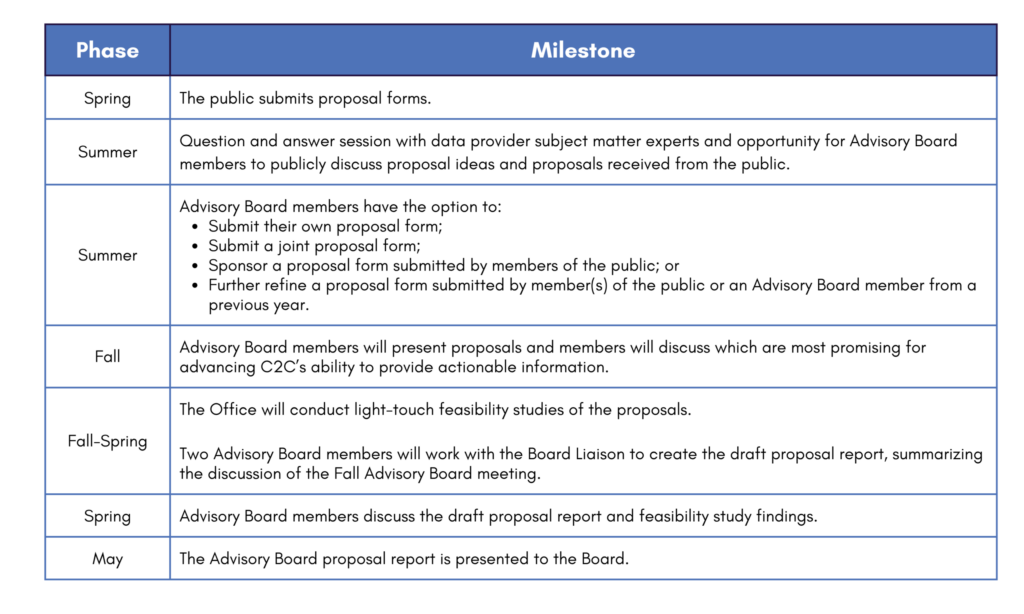
The proposal process runs on a yearly cycle, kicking off each spring and wrapping up the following May. The process is structured around four key phases: Spring, Summer, Fall, Spring, and May. The following chart outlines the cadence of the proposal process.
Update on the 2025 Advisory Board Proposal Process
In Summer 2025, the Office received four DTAB and two CEAB proposals which can be found in the proposal repository.
In Fall 2025, both DTAB and CEAB met to discuss the proposals and determine which proposals had the highest potential impact and benefit for providing actionable information to the people of California.
In Spring 2026, DTAB will meet on March 25, 2026 and the CEAB will meet on April 8, 2026 to discuss the Advisory Board proposal report and feasibility study findings. On May 20, 2026, the final Advisory Board proposal reports will be presented to the Governing Board.